Image Description
Our Sheep
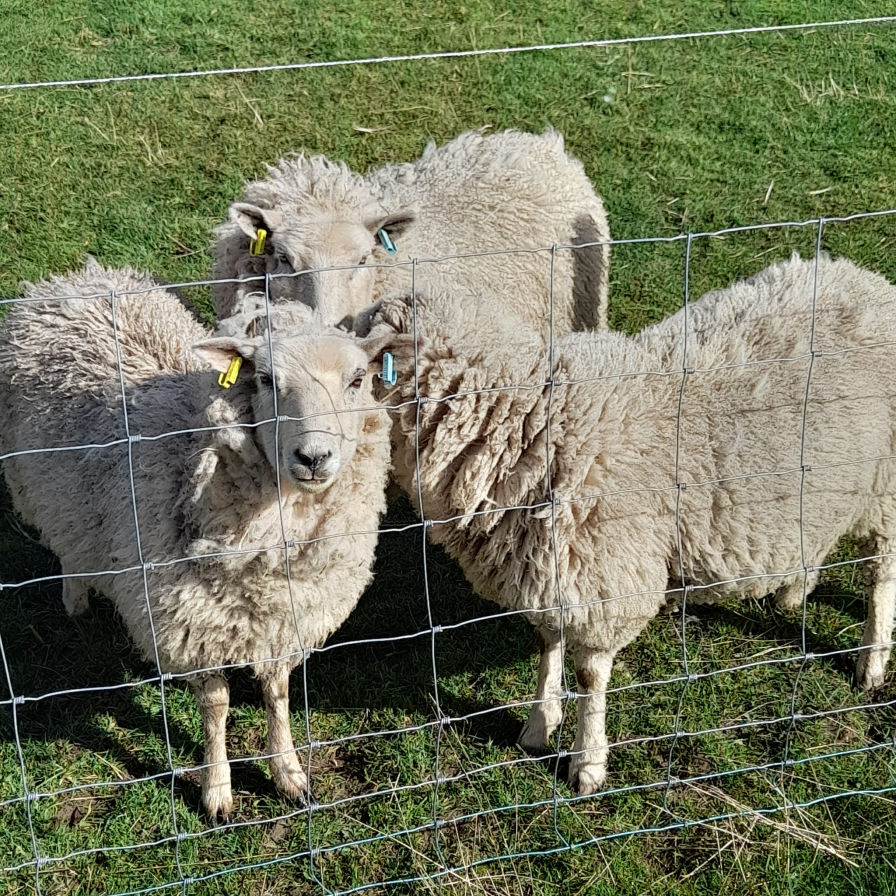
The Shetland is a small, wool-producing breed of sheep originating in the Shetland Isles, Scotland, but is now also kept in many other parts of the world. It is part of the Northern European short-tailed sheep group, and it is closely related to the extinct Scottish Dunface. Shetlands are classified as a landrace or "unimproved" breed. This breed is kept for its very fine wool, for meat, and for conservation grazing.
Although Shetlands are small and slow-growing compared to commercial breeds, they are hardy, thrifty, easy lambers, adaptable and long-lived. The Shetland breed has survived for centuries in difficult conditions and on a poor diet, but they thrive in better conditions. Shetlands retain many of their primitive survival instincts, so they are easier to care for than many modern breeds.
By the early twentieth century, the Shetland was perceived as threatened by cross-breeding, leading to a decline in wool quality. To combat this, the Shetland Flock Book Society was formed in 1927, and this remains the body responsible for the protection of the breed in Shetland.
By the time the Rare Breeds Survival Trust was set up in the 1970s, the Shetland had become rare, and it was listed by them as Category 2 (Endangered). Since then, the breed has become popular with smallholders, and it is now classified as Category 6 (Other native breeds), with a UK population of over 3000. On the mainland the breed is governed by the Shetland Sheep Society.
The wool produced by the Shetland has historically been a valuable commodity. Shetlands produce numerous shades of wool colours and this variety was commercially important to the wool industry of the Shetland Isles where natural wools are often used undyed. Tweed is also produced from the coarser Shetland wool, but the Isles are best known for their multi-coloured knitwear (made using Fair Isle knitting) and for the traditional knitted lace shawls which are so fine, they will pass through a wedding ring. Fleeces usually weigh between 2 and 4 lb (0.9 and 1.8 kg).
Like other "primitive" breeds, the ewes are highly seasonal, becoming fertile in October and November (in the Northern Hemisphere) and lambing in spring or summer. On the poor grazing of Shetland, the lambing percentage is about 130%. However, when the ewes are on better pasture, twin lambs are more common, especially from mature ewes. Shetland ewes are hardy, easy lambers, good mothers and produce ample milk. Healthy lambs are born with a weight between 4 and 7 lb (2 and 3 kg).
